
Searching Ohio County Criminal Dockets
Two state tools handle Ohio County criminal docket searches. After a CAPTCHA, the Magistrate Record Search lets you look up Magistrate Court matters. You can search by first name, last name, or case number. For public Circuit Court documents, WVPASS works after free registration. It confirms searches by party name, case number, or other filters. Keep in mind that neither one is a complete county database. Wheeling Police and Building Code Enforcement citations stay in the city court stream.
Begin with whichever court handled the first event. Misdemeanors, preliminary felony examinations, and warrant matters often start in Magistrate Court. When a felony goes forward after preliminary review, it moves to Circuit Court. If you know the case number, search with it, since names can match. Check the court and filing date. Check the charge and event history, too, before you treat a result as the right Ohio County criminal case.
- Choose Magistrate Record Search or WVPASS based on the court.
- Enter the exact case number, or use the party-name fields the portal supports.
- Open the likely result and check the court, charge, filing date, and disposition.
- Read later events for transfers, resets, judgments, and closed status.
- Ask the correct clerk for an official or certified criminal record.
Ohio County Criminal Search Limits
The magistrate gateway opens with a CAPTCHA and a public disclaimer. According to the Judiciary description, results are free but capped at 30. A broad name search can bury a relevant match outside that returned set. So narrow the query with the exact case number whenever you can. A result may list a filing date, charge, disposition, and a document-list reference, but it does not hand over the underlying court papers.
The Magistrate Record Search gateway displays the entry step and its validation warning.
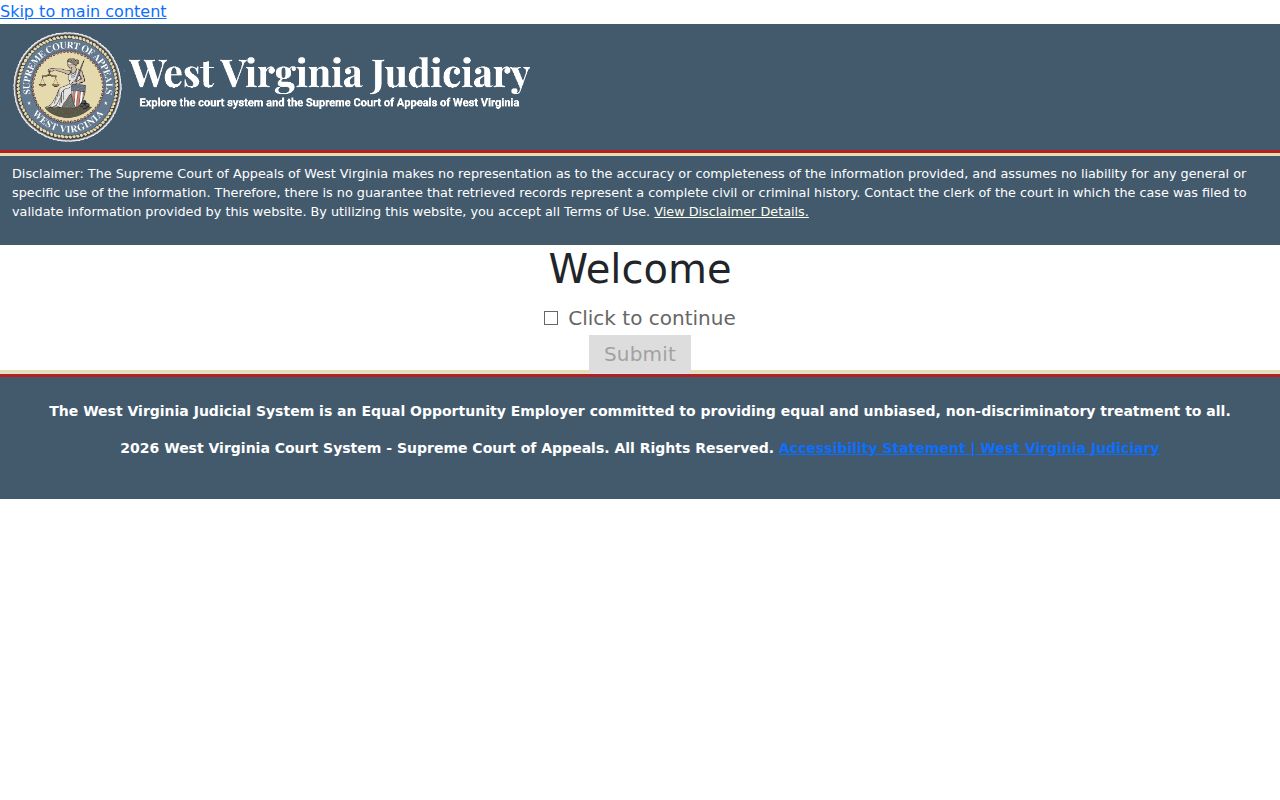
That warning is why the local clerk matters. When a result is unclear, a name pulls too many matches, or you need a copy, call the Ohio County Magistrate Clerk at 304-234-3709 or visit 26 Fifteenth Street in Wheeling. State launch materials also point to public terminals at magistrate clerk offices.
Note: A magistrate search result is an index, while the clerk-held file is the source for documents and validation.
Inside an Ohio County Criminal Docket
Think of a criminal register of actions as a time-ordered list. It can show what was filed, which hearing was set, whether a setting moved, and how the court closed an event. The official field inventory covers Record, Event Type, Date/Time, Room, Location, Judge, and Reason Closed. It also names Court Hearing, Motion to Continue, Notice of Hearing, Criminal Judgment, Bond Transferred to Circuit Court, and Transfer to Circuit Court. These labels describe procedure only. Read them for what they say, not for conclusions the entry never states.
| Case number | The court identifier; state payment-search examples include ##-M##X-##### and M##M-##########. |
|---|---|
| Charge | The alleged offense or citation shown for the case. |
| Setting | The event date, time, room, judge, and hearing type when available. |
| Bond or transfer | A release or security event, or movement from Magistrate to Circuit Court. |
| Disposition | The stated outcome or status, such as dismissed, convicted, acquitted, deferred, or transferred. |
Look past the charge line alone. A disposition tells you far more, though later orders can still shift a case's status. Read down to the newest Ohio County docket events, then ask the clerk to confirm what the record shows today.
Ohio County Criminal Docket Transfers
One felony can leave marks in two courts. Magistrate Court in Ohio County holds the preliminary examination. That step tests whether a felony matter should move forward at all. When it should, the register may show "Transfer to Circuit Court" and "Bond Transferred to Circuit Court." From that point, follow the Circuit docket for the heavier work: indictment-stage filings, motions, trial settings, pleas, judgment, and sentencing.
Docket flow: Complaint or Warrant › First Appearance › Preliminary Examination › Circuit Transfer › Plea or Trial › Disposition and Sentence
A transfer is neither a dismissal nor a conviction. All it means is that the Ohio County criminal docket moved up a court level. Search WVPASS for the Circuit side. If the public document does not appear, contact the Circuit Clerk. Remember that a downloaded WVPASS page is not certified. The clerk is the only certification route.
How a Criminal Case Moves
An early Ohio County criminal docket often lists a complaint, affidavit, citation, warrant, arraignment or first appearance, and bond. Motions and notices pile up next as the parties ask the court to act or the clerk records a setting. A continuance only means a scheduled event moved. It does not resolve the charge. Later entries may include a plea, hearing, trial, criminal judgment, sentence, costs, and a closed event.
"FTA" means failure to appear. That is a procedural event, not a final outcome. West Virginia rules and statutes allow notice, a warrant, costs, or DMV action in applicable cases, and the precise next step depends on the court and the offense. Anyone who spots FTA should contact that court promptly. Do not assume an online payment screen will fix a missed setting.
- Arraignment
- A hearing where the charge is stated and a plea may be entered.
- Continuance
- A court-approved move of a hearing to another date.
- Disposition
- The recorded result or current outcome of the case.
- FTA
- Failure to appear for a required court event.
Ohio County Criminal Filing Counts
What kind of criminal volume does Ohio County Circuit Court see? The 2024 Judiciary annual report sorts its criminal filings into four buckets: 126 felonies, 180 other criminal matters, one misdemeanor, and a single magistrate appeal. That adds up to 308 filings for the year. Keep in mind these are reporting categories from the state's own tally, not convictions, and one person with several charges can appear more than once.
Big yearly totals say a lot about the clerk's workload and nothing about your case. For the answer that matters, pull the Ohio County criminal docket. Use the specific case number. Read the latest entries closely. Then call the circuit clerk to confirm anything the record leaves unclear.
Courts That Hold Criminal Dockets
Several courts split the criminal caseload in Ohio County. Ohio County Magistrate Court takes the limited-jurisdiction work: misdemeanors, preliminary felony hearings, and arrest and search warrants. Its official office page marks the local clerk route and links out to the state's docket search and payment tools.
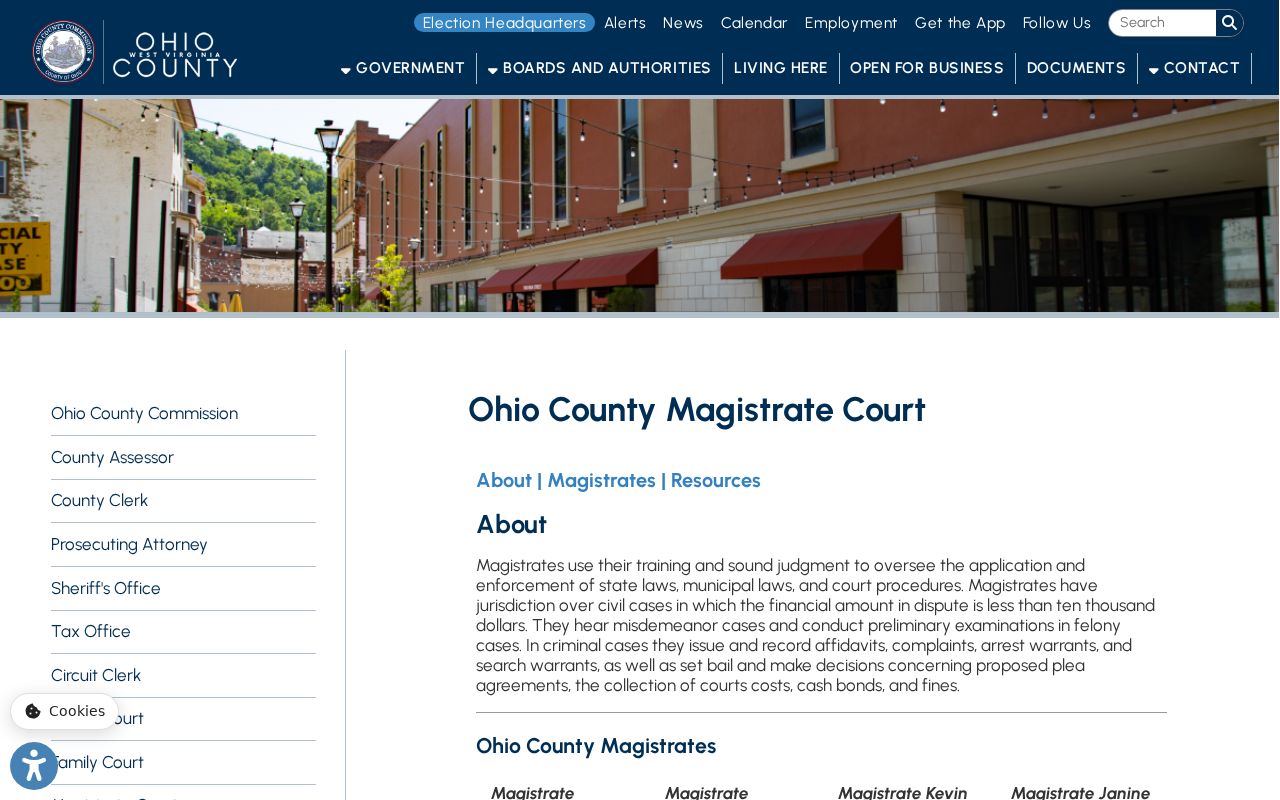
Every online Ohio County criminal docket result traces back to a live office. That office sits at 26 Fifteenth Street. That is where the records live. The Circuit Court there serves as the court of record with general jurisdiction, handling felony cases and certain misdemeanors. Its public filings sit in WVPASS. Certified copies come straight from the Circuit Clerk's file room at 1500 Chapline Street.
Wheeling Municipal Court stands apart from all of that. It handles Wheeling criminal citations, traffic tickets, and building-code matters. Don't push a city citation into Magistrate Record Search just because both streams involve offenses; they are different dockets. Federal charges filed in the Northern District Wheeling Division run through PACER and CM/ECF, not either state portal.
Ohio County Criminal Docket Copies
The two state systems cover different layers of an Ohio County court docket. WVPASS holds publicly available Circuit Court documents dating from July 1, 1999. Registration is free. After that, public users pay $0.25 per document page plus processing to view or download a filing. Magistrate Record Search costs nothing. But its document list is only a reference. Actual Magistrate Court papers must come from the local clerk.
| Route | What it provides | Copy path |
|---|---|---|
| WVPASS | Circuit search and available documents | Circuit Clerk |
| Magistrate search | Results, events, charges, disposition | Magistrate Clerk |
| Clerk counter | Inspection, validation, available copies | Clerk for that court |
One caution on copies: paying WVPASS for a page does not certify it. State law sets a separate $1 per-page Circuit Clerk charge for any paper leaving the office. Certification carries its own price. Confirm that with the clerk. When you order, say whether you want a plain or certified copy. Give the case number and the document date too.
Sealed Dockets and Public Access
W. Va. Code §51-4-2 sets the baseline. Court records and papers are open unless another law says otherwise. Openness stops at sealed, expunged, or confidential material. WVPASS excludes sealed filings and juvenile cases. Juvenile proceedings are generally nonpublic, and expungement can restrict eligible criminal material once the required court process is complete.
A missing docket result can mean the wrong court, a spelling slip, a gap in portal coverage, a very recent filing, or an access restriction. Call the proper clerk with a specific case number and document request. West Virginia FOIA permits an oral request. A clear written one is easier to track. The law never requires an agency to create a new record.
Key Rules:
W. Va. Code §49-5-101 protects juvenile information and records, subject to limited exceptions.
W. Va. Code §61-11-25 provides expungement routes for specified case outcomes.
Trial Court Rules 10.03 and 10.04 address access limits and court-file access.
Note: Public access does not make every filing, attachment, juvenile matter, or sealed order available through an online portal.
Ohio County Criminal Cost Entries
Money entries on a criminal docket demand careful reading. Under W. Va. Code §59-1-11, the Circuit Clerk criminal cost tax runs $85 for a misdemeanor and $105 for a felony. The same statute lists $25 for processing a bond instrument, except a personal-recognizance bond. None of those clerk charges is the criminal fine, the restitution, or the bond amount.
Read the entry name before deciding what is owed. A cost assessment, a payment plan, a bond, a fine, and restitution each play a different role. The docket may record that a financial event occurred. It may not give a complete current payoff figure. Confirm the balance and accepted payment route with the court that entered it. Online payment tools are not complete criminal docket searches.
The register can also show whether costs were assessed at judgment or whether a later payment event posted. It still cannot be read safely without the related order. A payment balance does not state the charge outcome. A bond entry does not state guilt. Keep every financial line in its procedural context.